The Myth: "I Just Need Another Coat of Paint"
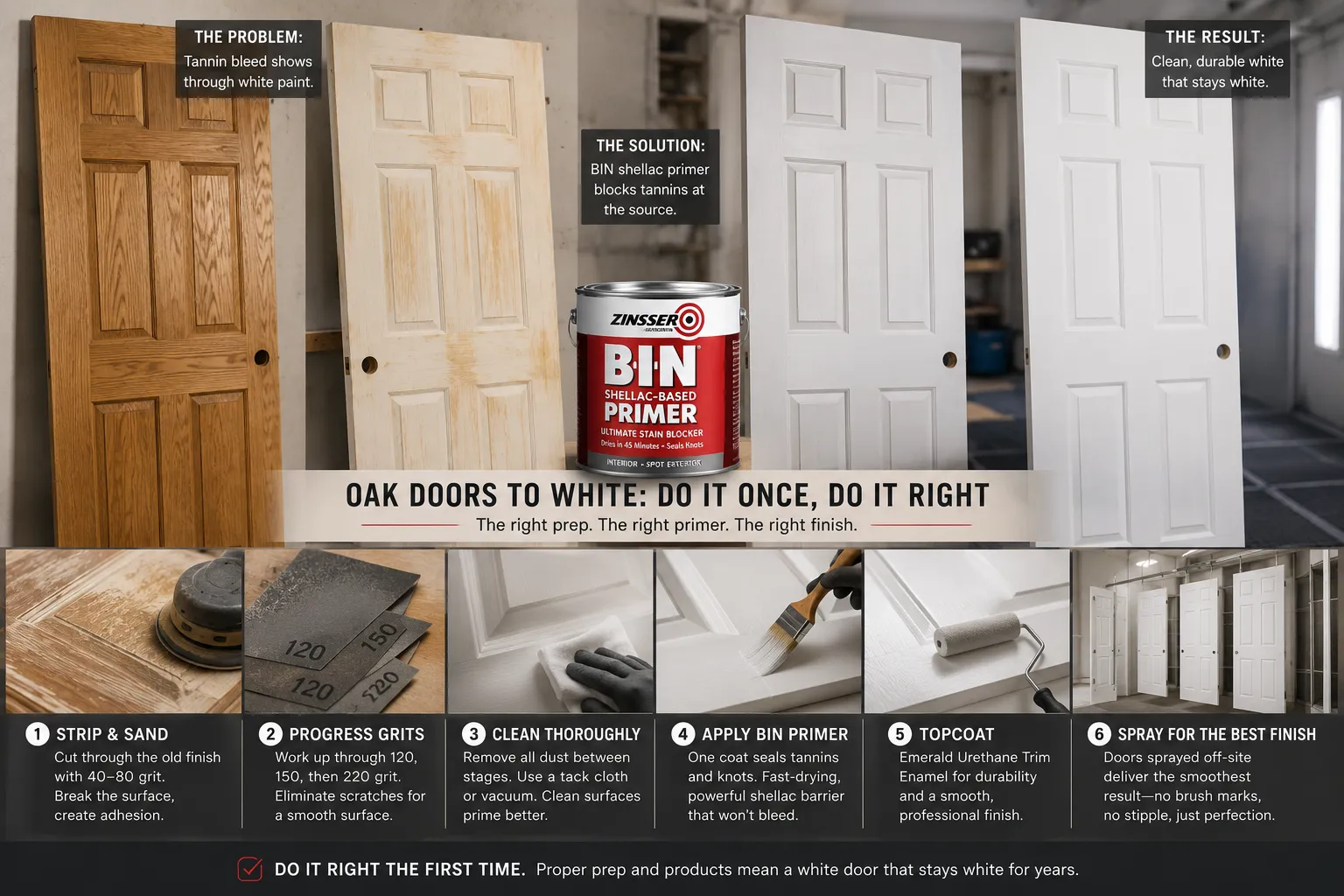
This is the most common thing we hear from homeowners who've tried converting their stained oak interior doors to white. The doors look fine the day of painting, then a week later there's a warm, yellowish cast bleeding through — sometimes subtle, sometimes hard to miss. The instinct is to add another coat of white paint. Then another.
It doesn't help. The yellow keeps coming back.
The problem isn't the paint. It's what's underneath it.
What's Actually Happening: Tannin Migration
Oak is a high-tannin wood. Tannins are the natural compounds that give oak its rich, warm color — great for stain, genuinely problematic when you're trying to go white. When you apply water-based paint directly over raw or stained oak, moisture from the paint activates those tannins and pulls them up through the wet film. They settle on the surface as the paint dries, leaving that ghost of yellow-brown behind.
Stained oak is especially prone to this because the tannins are already saturated and close to the surface. Even if you sand the old finish down, the wood itself still contains them.
No amount of additional topcoat fixes tannin migration. You have to block it at the source.
The Fix: BIN Shellac Primer
Shellac-based primer — specifically Zinsser BIN — is the right tool for this. Shellac creates a hard, alcohol-based barrier that tannins simply cannot penetrate. Water-based primers, even "stain-blocking" ones, are frequently not enough for high-tannin species like oak or walnut. We've seen latex stain-blockers fail on oak doors more than once.
BIN goes on, dries fast, and locks everything below it in place. When the topcoat goes on over properly primed wood, there's nothing left to migrate.
One coat of the wrong primer can waste a full paint job. One coat of shellac primer applied correctly sets the whole project up to hold.
The Prep Work That Actually Matters
Primer alone won't save a door that wasn't prepped. Here's what the process looks like when it's done right:
- Start coarse, finish fine. Oak doors with an old urethane or lacquer finish need to be cut back aggressively — think 40 or 80 grit to break through the existing topcoat and give the primer something to grip. Skipping this step means primer adhesion is weak no matter what product you use.
- Work up through the grits. After the initial cut, progressive sanding — moving from coarser grits up through 150 and then 220 — removes the deep scratches left by the coarser paper. If you spray a finish over 80-grit scratches, the scratches show. Fine finish work requires fine prep.
- Clean between every stage. Sanding dust is an adhesion killer. Wipe down with a tack cloth or vacuum the surface before primer and before each topcoat.
- Fill and spot-prime any bare areas. Old hardware holes, dents, or deep grain that telegraphs through the primer all need attention before the final coats go on.
Rushing prep is the single most common reason a door refinishing project looks good for six months and then starts peeling or chipping at the edges.
Why the Finish Coat Matters Too
Once the BIN primer has blocked the tannins and the surface is properly built up and sanded to 220, the topcoat determines how the door actually holds up over years of use.
For interior doors, Sherwin-Williams Emerald Urethane Trim Enamel is a strong choice. It cures hard, resists scuffs and cleaning, and lays out smoothly. Brushed and rolled, it's acceptable. Sprayed in a controlled environment, the difference is visible — no brush marks, no stipple texture, just a clean, consistent film.
Doors pulled from their hinges and sprayed in a booth (rather than painted in place) give you the best result. Gravity works in your favor, overspray is controlled, and you can coat all four edges evenly. Re-hanging a fully cured door is a much cleaner outcome than trying to cut in around hardware and hinges while the door swings.
What DIY Gets Right — and Where It Goes Wrong
DIY door painting isn't impossible. Plenty of homeowners get decent results. But the tannin bleed problem catches people off guard because it doesn't show up immediately. You finish the job, it looks great, and then a week later the yellow appears. At that point you've already re-hung the doors and cleaned up.
The other common miss is the grit progression. Grabbing a sheet of 120-grit sandpaper and scuffing the surface lightly is not the same as cutting through an old urethane finish. The primer sits on top of the old coating rather than bonding to the wood, and the whole thing fails at the edges where doors take the most abuse.
Getting it right the first time costs less than fixing it twice.
Thinking About Your Own Doors?
If you have oak or other stained interior doors you're considering converting to white — or if a previous attempt has already shown yellowing — it's worth having someone look at what you're working with before committing to a process.
We work on interior doors throughout Douglas County, including Castle Rock, Parker, and the surrounding communities. Take a look at our door painting work, or browse the interior painting service for a broader picture of what the process covers.
When you're ready for an actual number, request a free estimate and we'll come take a look in person.