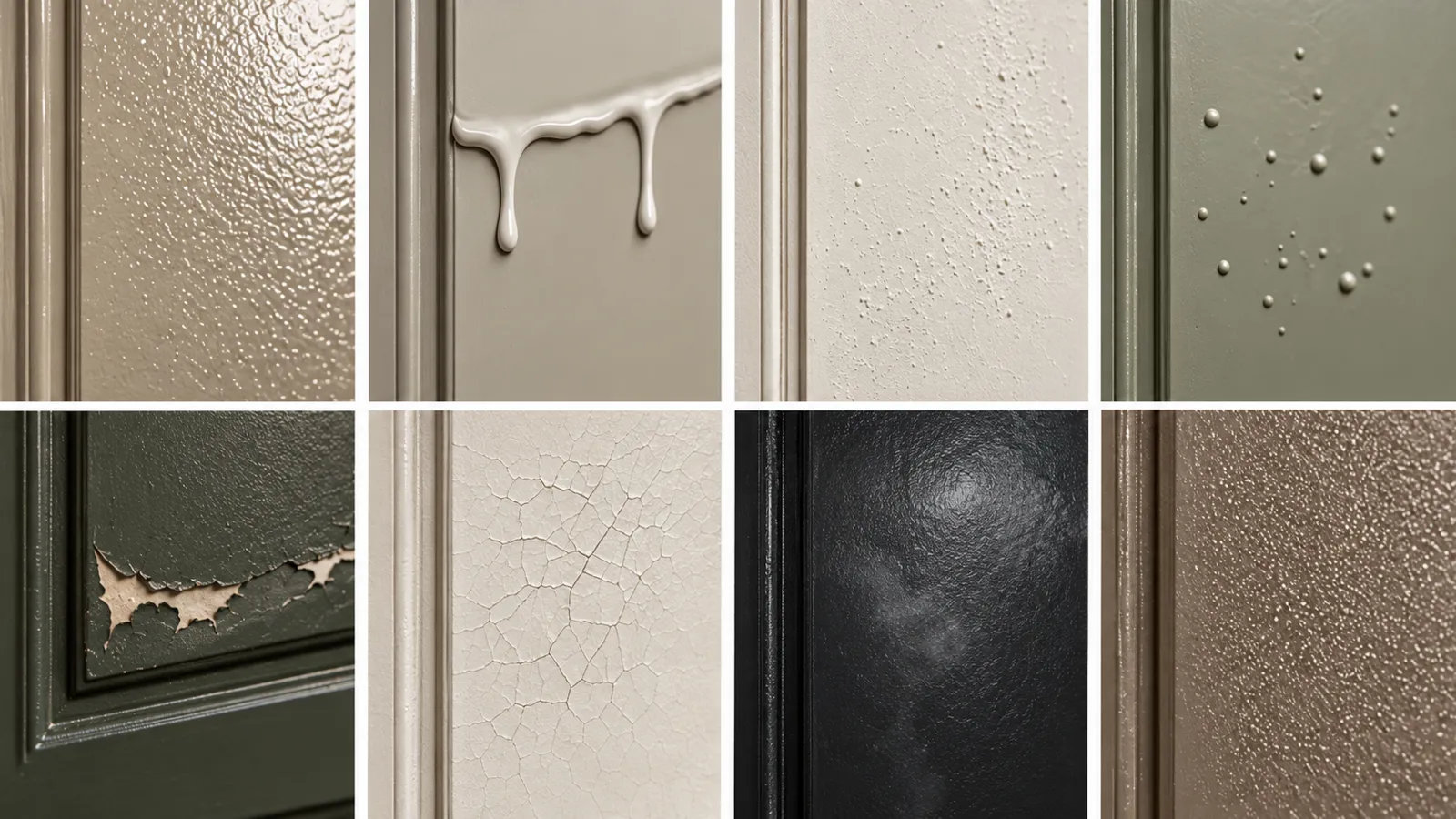
A sprayed cabinet finish is unforgiving. Paint on a wall hides a lot; paint on a cabinet door, at eye level, in kitchen light, hides nothing. So when a cabinet job goes wrong, it doesn't go wrong quietly. Homeowners call us with photos, and the photos almost always show one of the same eight problems.
The useful thing about those eight is that each one has a specific cause. A defect is a record of what happened in the booth, or the garage, on the day the doors were sprayed. Once you can read it, you know what the last painter skipped, and you know whether the fix is a day of sanding or a full strip.
Here's how we read them.
1. Orange peel
What you see: a fine, dimpled texture across the whole door, like the skin of an orange. The color is right, the coverage is right, but the surface never flowed out flat.
Why it happens: the paint was too thick for the gun, the pressure was wrong, or the sprayer was held too far away and the droplets half-dried before they landed. It's a setup problem, not a paint problem. You'll see it on cheap sprayers and on expensive ones run wrong.
Fixable? Yes, and usually without stripping. Light orange peel sands flat with fine paper and takes a properly set-up topcoat. Heavy orange peel takes more sanding, but the paint underneath is sound.
2. Runs and sags
What you see: drips at the bottom edge of a door, or a heavy curtain of paint under a raised panel that never leveled.
Why it happens: too much paint in one pass, or a second coat over a first that hadn't flashed off. Almost always, the door was sprayed standing up. Gravity does the rest.
Fixable? Yes. Runs are sanded back to level and the door is recoated. The tell is that the fix has to happen with the door lying flat, which is why our doors are sprayed flat on racks in the first place. A run can't form on a horizontal surface.
3. Dust nibs
What you see: small bumps scattered across the finish that you can feel with a fingertip. Under raking light they look like grit under the paint, because that's what they are.
Why it happens: dust in the air where the doors were sprayed, or a door that wasn't tack-clothed before the coat. A garage with the door open is a dust machine. So is a kitchen with the HVAC running.
Fixable? Yes. Nibs sand out and the door takes a clean final coat. If the last painter sprayed in a garage, every door will have them, so this is usually a full recoat rather than a touch-up.
4. Pinholes
What you see: tiny craters in the finish, like bubbles that popped as the paint dried.
Why it happens: something trapped under the film escaped as it cured. Moisture in the wood, solvent trapped by a coat applied too soon over the last one, or air in open-grain wood like oak that wasn't sealed first.
Fixable? It depends on the cause. Solvent pop from rushed coats sands out and recoats. Pinholes over unsealed oak grain need the door taken back far enough to fill and seal the grain properly, or they'll come right back.
5. Peeling and chipping
What you see: paint flaking off at the edges, at the corners of the panel, or anywhere a fingernail catches. This is the defect that makes people call us.
Why it happens: the paint never bonded. Either the old finish wasn't cleaned (kitchen grease is the usual culprit), it wasn't deglossed, or it went on without a bonding primer. Factory cabinet finishes are slick by design. Paint that isn't given something to grip will let go, and it usually lets go within the first year.
Fixable? Not with another coat. Paint over peeling paint peels too. This one means the failing finish comes off, the doors are cleaned and deglossed properly, and the whole system goes back on from the primer up. It's the most expensive defect to inherit, and it's the one that a proper cleaning step at the start would have prevented.
6. Cracking
What you see: a web of fine cracks in the surface, sometimes only visible up close, sometimes obvious.
Why it happens: the film was stressed. Paint was thinned too far, a topcoat went over a primer that wasn't cured, two products that don't belong together were stacked, or a two-part product was mixed at the wrong ratio.
Fixable? Usually only by taking the cracked layers off. Cracks telegraph through anything applied over them. If the cracking is confined to the top coat, it can be sanded back; if it runs down to the wood, the door gets stripped.
7. Blushing
What you see: a milky, cloudy haze in the finish, worst in the darker colors.
Why it happens: humidity. The paint trapped moisture as it dried, either from a humid day or from a solvent-heavy coat that cooled the surface and pulled water out of the air. It's a sign the doors were sprayed somewhere without climate control.
Fixable? Yes. Blushing is in the topcoat, so the door is sanded and recoated under controlled conditions. It won't come back if the booth is dry.
8. Dry spray
What you see: a rough, sandpaper feel, sometimes with a dull, chalky look, often on the edges and profiles of a door rather than the flat center.
Why it happens: the paint dried in the air before it reached the surface. The gun was too far away, the pressure was too low, or the painter moved too fast to lay a wet coat.
Fixable? Yes. It sands smooth and recoats. Like orange peel, it's a technique problem, and it usually shows up on every door in the kitchen because the technique didn't change from one to the next.
What the pattern tells you
Look at the list again. Three of the eight are gun setup. Two are booth conditions. Three are prep and product. None of them are bad luck. Every one traces to a decision made before the trigger was pulled, which is why a bid that describes prep and process line by line is worth more than one that describes the paint.
The one that matters most is peeling, because it's the only one a fresh coat can't fix, and it's the one that follows from the cheapest shortcut: skipping the cleaning and deglossing that makes a factory finish paintable.
How we take over a botched cabinet job
When a homeowner sends us photos of someone else's work, this is what happens next.
We look before we quote. At the walk-through we check a few doors up close, especially the edges and corners where paint fails first, and we talk through what the last painter did and when. That usually tells us whether the existing finish is sound enough to recoat or has to come off, and the estimate says which.
If it's a close call, we fix one door first. Rather than guess, we'll take a single door to the shop, put it through our full process, and bring it back. You see the result on your own cabinet before committing to the kitchen, and we learn exactly how the old finish behaves under prep, which is the only reliable way to know. If the test door tells us the whole finish has to be stripped, you find that out on one door instead of forty.
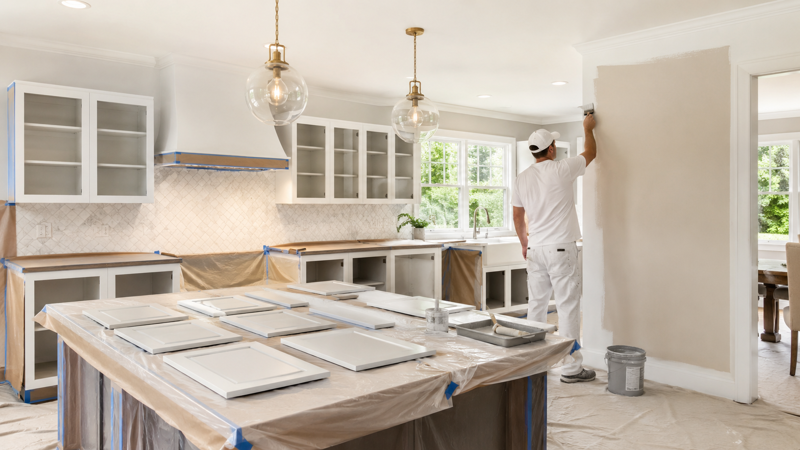
The doors come off and go to the shop. Every door and drawer front comes to our booth in Littleton. That alone eliminates three of the eight defects, because the booth is climate-controlled, filtered, and dry. What stays in the kitchen, the boxes and face frames, gets the same prep and is finished in place.
Prep is the job. Doors are cleaned to remove grease, sanded or deglossed depending on what's on them, cleaned again, and primed with a bonding primer. If the last finish is coming off, it comes off here. This is the step the previous painter skipped, so it's the step we don't.
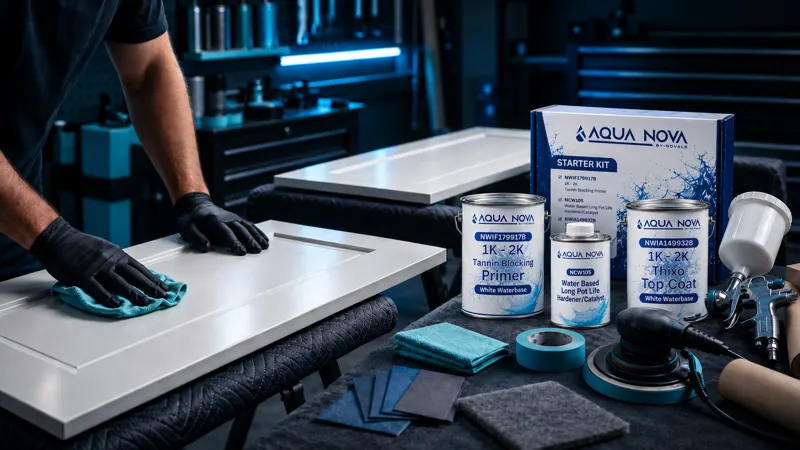
Doors are sprayed flat. Two coats of primer and two coats of finish, each one sanded between, with the doors horizontal on racks. Runs can't form. Coats get their full flash time. The finish we use on cabinets is Novalk, a two-part industrial coating that cures hard rather than staying soft for weeks the way a trim paint does on a door.
We put it in writing. Sprayed cabinets carry our 10-year workmanship warranty, the same as any cabinet job we do from scratch. If a defect we fixed comes back, that's on us, and the warranty page says exactly what's covered.
When it isn't worth saving
Occasionally a job is too far gone. Doors that have been stripped roughly enough to gouge the wood, MDF doors that swelled from a wet strip, or panels that cracked through are sometimes better replaced than refinished. We'll tell you that at the walk-through rather than spend your money finding out. Most of the time, though, the bones are fine. It was the process that failed, and the process is the part we can redo.
If you're looking at a kitchen with any of the eight above, send us a few photos with your estimate request. We'll tell you which one you're looking at, what caused it, and what fixing it properly involves.