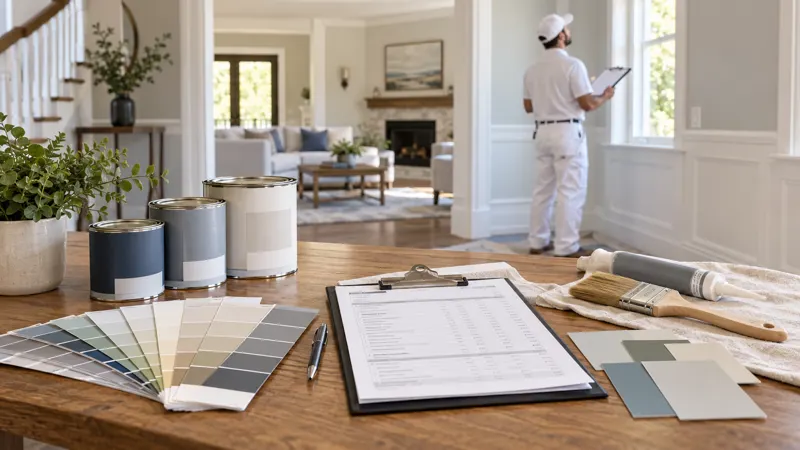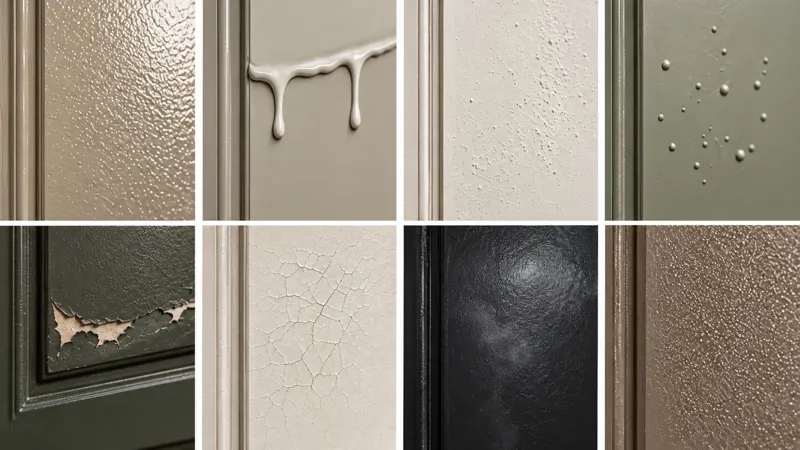
A painting bid is a promise written down before the work starts. The trouble is that most of them are written to be short. A number, a paragraph, a signature line. When something goes wrong later, the paragraph is what everyone reads, and it rarely says enough to settle it.
Here are the six things a bid should state, in writing, and what it usually means when one is missing. None of this is about price. Two honest bids can be far apart on price for good reasons. It's about whether you can tell what you're buying.
1. The prep, line by line
Paint fails at the prep, not at the can. A bid should say what happens before the first coat: wash, scrape, sand, caulk, prime, and where. On an exterior, which elevations get scraped and which get spot-primed. On an interior, whether holes are patched, whether trim is caulked, whether stained wood gets a bonding primer.
The red flag: "full prep" or "prep as needed" with nothing behind it. Those phrases mean the crew decides on the day, and on the day the incentive runs toward less.
2. Product and sheen, per surface
Walls, ceilings, trim, doors and exterior siding take different products and different sheens. A bid should name the manufacturer and the line for each, and the sheen. Matte or satin on walls, flat on ceilings, semi-gloss on trim and doors is a common, sensible scheme; the point is that it's written down. Cabinets are their own line: the bid should say whether the doors come off and get sprayed in a shop or get brushed in place, and what finish goes on them. A trim paint and a two-part cabinet finish are not the same product, and they don't wear the same.
The red flag: "premium paint" with no product name, or one product listed for the whole house. You can't check a warranty, a color match or a touch-up later against "premium."
3. How many coats, and where
Two coats is the standard for a color change and for exterior work. One coat is sometimes fine for a same-color refresh. Either can be right; the bid should say which it is and on what.
The red flag: no coat count at all, or "coats as needed." A second coat is a full day of labor on a big job, and it's the first thing to quietly disappear when a bid was priced too low.
4. What's not included
A good bid draws the line as clearly as it draws the scope. Are ceilings in? Closets? The inside of the garage door? Wood rot found under failing paint? Drywall repair beyond patching nail holes? Moving furniture?
The red flag: a bid with no exclusions section. It doesn't mean everything is included. It means the conversation about what wasn't will happen after the deposit.
On that last point: when a painter finds a wall that needs real drywall work, a patch that isn't a patch, the honest move is to say so and price it, not to skim it and paint over it. Our sister company handles that side for us, and a bid that names who does the repair is a bid that planned for it.
5. Warranty terms, including the exclusions
A warranty is a promise about the future, so it belongs in writing before the work, not on a card afterward. Length is the easy part, and it should be stated per surface, since interior walls, exterior siding and cabinets rarely carry the same term. Ours runs five to fourteen years by product: nine on our default exterior paint, ten on interior trim and doors, ten on sprayed cabinets. The exclusions decide what it's worth: hail and severe weather, settling cracks, moisture from behind the film, horizontal surfaces that hold water. Most warranties exclude these, ours included, and there's nothing wrong with that as long as it's stated.
The red flag: a warranty quoted in years with no terms attached, or a warranty that gets longer with the package price while the exclusions stay the same. Read the exclusions before you value the years.
6. Proof of insurance
Colorado doesn't license painters, so "licensed" on a painting bid is either a business license, which is a tax registration, or a word. What protects you is insurance: general liability for your property and workers' compensation for the people on your roof.
The red flag: If they can't prove they have insurance, that means a big risk for you, it might also be why the "price is cheaper" than other bids.
If the bid comes in three tiers
Good, Better, Best isn't an accident either. Three tiers exist to make the middle one look sensible. The bottom tier is priced and described to be rejected: thin warranty, the cheapest paint, a name like "Basic" that nobody wants on their house. The top tier is priced high enough that the middle looks like the reasonable choice by comparison. Most buyers pick the middle, which is the one the bid was built around all along, and they feel like they made a careful decision. The structure tells you nothing about the paint or the prep. It tells you where the seller wanted you to land. Run the seven questions above against whichever tier you're considering; if the prep and the exclusions are identical across all three, the tiers are a price menu, not a quality menu. There's a longer look at the arithmetic in what's actually inside a painting package.
What a bid looks like when it has all six
It's longer than a paragraph, and it reads like a checklist you could walk the house with. Prep by area. Product and sheen by surface. Coats. Exclusions. Warranty terms. Ours is written that way and delivered within 24 hours of the walk-through, itemized, with the warranty page linked so the terms are the same ones you'll sign.
If you have bids in hand and one of them is a number and a paragraph, it isn't necessarily a bad painter. It's a bid that hasn't told you enough yet. Ask for the seven things. How they answer will tell you the rest.