Our shop is in Littleton, so Littleton houses are the ones we know best, and they're the oldest ones we paint. The town grew up around a downtown that predates the car, and the neighborhoods rolled out from there by decade: bungalows and Victorians near Main Street, mid-century ranches through the '50s and '60s, Ken Caryl and Southbridge in the '70s and '80s, Grant Ranch in the late '90s, and Littleton Village in the last few years. On a lot of these streets the house has been painted six or eight times. That makes an exterior repaint in Littleton a different job than it is in the newer towns to the south, and here's what's different about it.
Old paint is a history, and you paint over all of it
A Castle Rock exterior has one coat under the new one. A Littleton bungalow might have a dozen, in oil and latex, brushed and sprayed, some of them applied over chalk or bare wood by whoever owned the place in 1985. The new paint is bonded to that stack, and it holds only as well as the weakest layer in it. That's why the first hour of a Littleton exterior job is spent finding out what's letting go: scraping test patches, pressing a thumbnail into the old film, looking for the alligatoring that means an oil layer has gone brittle under a latex one.
Where the old paint is sound, we clean it, scuff it and go over it. Where it's failing, it comes off to a sound edge, gets feathered, and gets primed. On an old house that scraping is the job; the color at the end is the easy part.
Pre-1978 homes and lead-safe work
Most of Littleton's downtown blocks, the mid-century ranches, and the early Ken Caryl homes predate 1978, which means some of those old paint layers may contain lead. We don't test every house, but we assume it on older homes and work accordingly when we disturb old paint: containment under the work area, no dry power sanding of suspect layers, careful clean-up so dust doesn't end up in the garden or the house. Tell us the home's age at the estimate and we'll plan the prep around it. It adds a little time. It's not optional.
What Littleton siding is, and what it needs
| What's on the house | Where you'll find it | What the repaint has to do |
|---|---|---|
| Original wood clapboard and shingle | Historic downtown, the older mid-century blocks | Scrape to a sound edge, replace split boards, prime bare wood, caulk, two coats |
| Redwood and cedar siding and trim | Ken Caryl, Columbine Valley, Bow Mar | Sand weathered wood back, treat mildew on the shaded sides, penetrating stain or paint over primer |
| Painted brick and stone | Mid-century ranches, some downtown homes | Breathable masonry coating only; never trap moisture behind the finish |
| Hardboard and early fiber cement | Southbridge, Grant Ranch | Check for swelling at the bottom edges, prime any exposed core, caulk, UV-rated acrylic |
| Stucco and modern fiber cement | Littleton Village, newer infill | Wash, patch cracks, two coats; often the first real repaint the house has had |
Trim, fascia and window surrounds are where Littleton exteriors fail first, and on the old wood houses they've been repaired before. We take those repairs back to sound material rather than adding another coat over a soft spot, and where a board is gone we replace it before anything gets painted.
Choosing colors on an older house
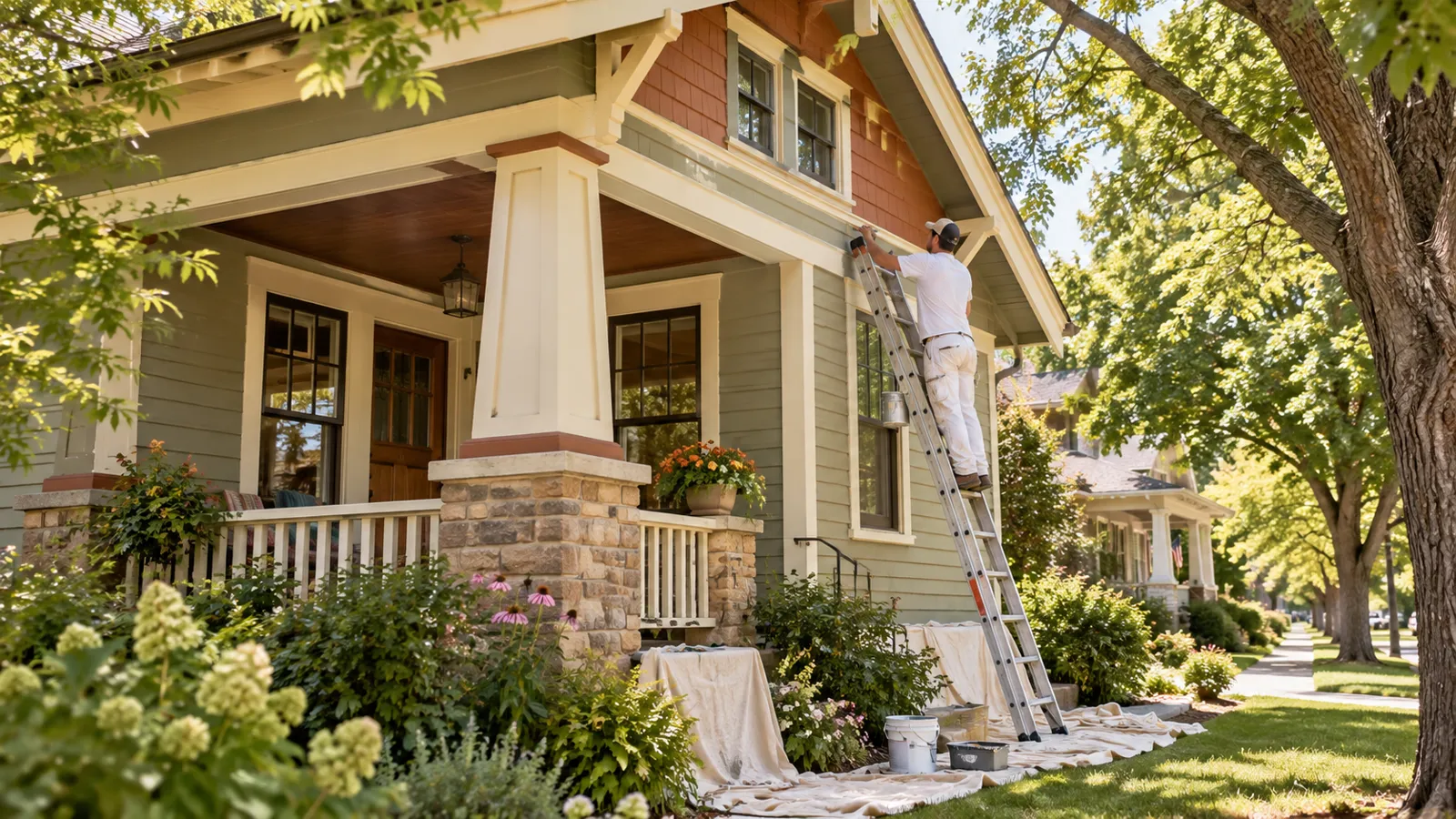
Littleton's older streets carry their era in the paint. A Craftsman bungalow near downtown wants a body color and two trim colors, with the porch and window sashes picked out; a mid-century ranch wants a quieter scheme with the brick left alone; a Ken Caryl two-story from 1980 has its master association's approved palette to work within. We're happy to steer this. The historic look isn't a rule, and plenty of downtown homes look right in a current warm white, but the color should suit the house you have, not the one across town.
The associations matter here too. Ken Caryl Ranch, Grant Ranch and Columbine Valley review exterior colors; the older downtown streets and the mid-century blocks mostly don't. We supply the specs for the submission where one is needed.
Why home base changes the job
Being minutes away isn't a slogan on a Littleton exterior. It's the reason we can split a scrape-heavy job across the weather, come back the day the rain stops, and be around for the touch-up when the sprinkler hits the fresh trim in July. It's also why Littleton gets the shortest turnaround we offer on doors and shutters that come to the shop for spraying. The Sherwin-Williams and Benjamin Moore stores we buy from are on our way to the job, so a color change mid-project isn't a lost day.
What we use, and what backs it
Two coats of a UV-rated Sherwin-Williams or Benjamin Moore exterior line over the prep above, a penetrating stain on cedar and redwood where the owner wants the wood to show, and a breathable masonry coating on brick and stucco. The estimate names the product for every surface. The warranty is a 100% workmanship guarantee plus a materials warranty that follows the product, up to 14 years, which on an old house is mostly a promise about the prep.
Frequently asked questions
How do I know if my old paint has lead? If the house was built before 1978, assume some layers might. We follow lead-safe practices on those homes when we disturb old paint. A test kit or a certified inspector can confirm if you want to know for sure.
My house has been painted many times. Does it all have to come off? No. Sound paint stays and gets scuffed and cleaned; only the failing layers come off to a sound edge. Stripping a whole house to bare wood is rarely necessary and rarely worth it.
Can you match the historic look of a downtown Littleton home? Yes. We'll work out a body-and-trim scheme that suits the era, or a current palette that respects the architecture, whichever you prefer.
Does Ken Caryl need to approve my colors? Yes, the master association reviews exterior colors. Grant Ranch and Columbine Valley do too. We supply the product and color specs for the submission.
What about the brick on my mid-century ranch? Most owners leave it. If you want it painted, it takes a masonry primer and a breathable topcoat so moisture can escape. Painted brick can't easily be unpainted, so we'll talk it through first.
How long does an exterior repaint on an older Littleton home take? Longer than a new build: typically four to six working days, most of it prep. The estimate gives you the actual timeline for your house.
The house has a history. Let's paint it like we know that.
Send a few photos of the worst side, or ask us to come look; we're close. We'll tell you what's under the current coat, what has to come off, what needs replacing, and what the paint will be, in writing, with the warranty spelled out.